

What is executive presence?
Executive presence is the ability to project confidence, credibility, and composure under pressure, inspiring trust and alignment in others. Rooted in gravitas, clear communication, and authentic emotional intelligence, it signals readiness for high-stakes leadership and moves teams toward decisive action.
Ask anyone to define executive presence and you'll hear the same words: confidence, clarity, resilience under pressure. Forbes boils it down to your ability to inspire confidence: in the people you lead, in your peers, and above all in the senior leaders who decide your next opportunity.
In our mind's eye, executive presence looks like this: You take the podium and command the room without effort. You speak with confidence and clarity, and the audience nods along: yes, this is the path. You walk into a room of thousands, and people stop and turn toward you, wanting your wisdom.
When pandemonium breaks out, you act with clarity and resolve. When the room boils over with anger, you know exactly what to say to restore order. You may be small in stature, but you loom large in people's minds. You are the first call and the last.
That's a lot to live up to.
Executive is the easy part
Strip away "presence," and an executive is simply a senior leader responsible for strategy, governance and enterprise performance. You do this every day. You already have the skills and the experience.
It's the word "presence" that carries the weight.
Where the ‘presence’ in executive presence gets its mystique
"Presence" has always had an otherworldly ring. In the 1660s, English borrowed "presence of mind" from the French présence d'esprit, and esprit means both mind and spirit. This was the age of Descartes, when the self became an object of attention. Composure became a matter of the rational mind being present and in command: its own sovereign presence.
So when we say "executive presence," we invoke something close to divine. That's a lot to expect from any leader.
But trace the word back to its Latin root, praesentia: being at hand. Here's the surprise. The fantasy of commanding a room and staying steady in a crisis is built on that plain, classical meaning.
To have executive presence, you have to get present.
Why stress shrinks your presence
When you get out of your head and into the moment, your field of view widens. Things slow down, and you see more.
Under stress, the opposite happens. Your brain revs up to pin down the danger, your focus narrows, and you fall back on messy shortcuts. The skills you rely on every day become harder to reach, exactly when you need them most.
This is why Forbes ranks operating calmly under stress and listening with full attention among the key ways to build executive presence. Both start with being present. The good news: getting present is a skill. If you think this is headed toward mindful meditation, take a breath. This is not our path today. Communication here requires relationship.
How to build executive presence: Four questions to ask yourself
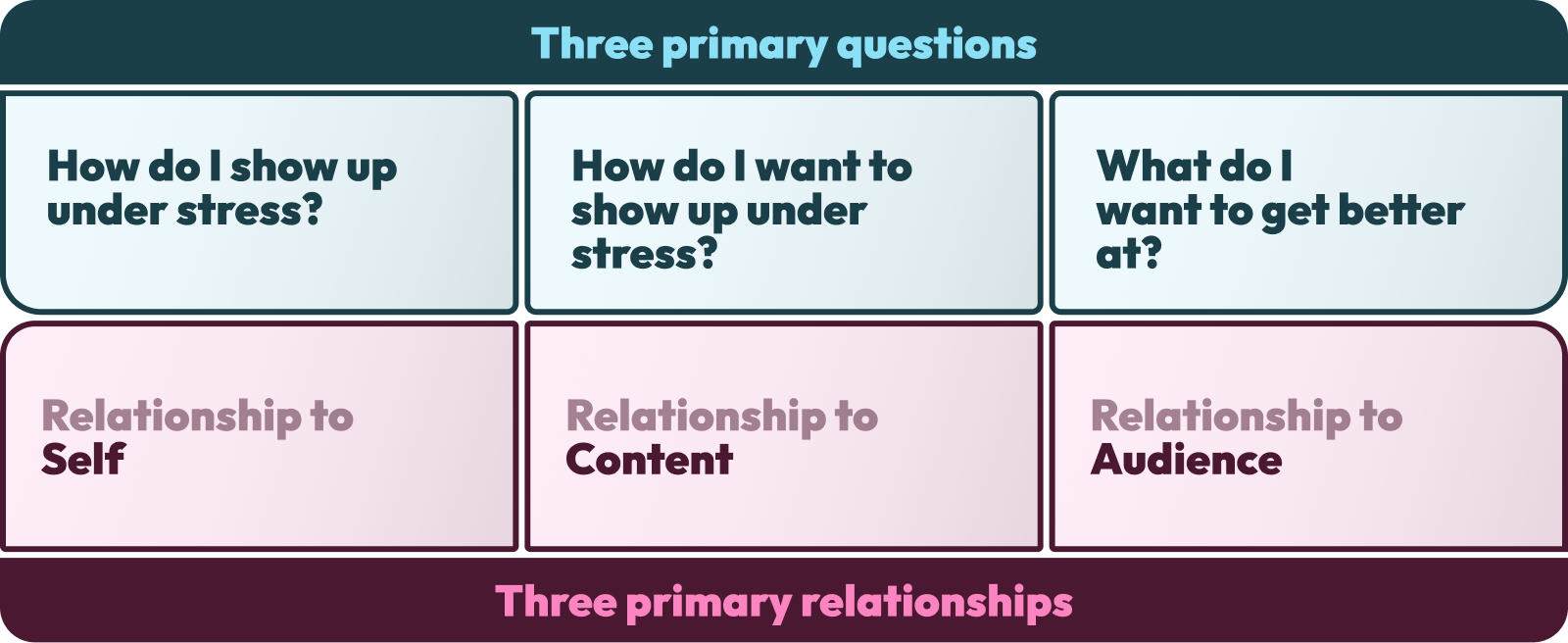
The following four questions come from Connection Lab’s Six-Box Model. Ask them before you walk into the room, and come back to them when stress starts to take over.
1. How’s my breathing? Settle your body with breath
Presence starts in the body, and breath is the fastest way in. One full, conscious breath calms your nervous system right away. It moves you out of fight-or-flight and into a calm, present state. Let go of tension, relax your body and make room for your breath.
2. Does my audience feel seen and heard? Get present and connect through curiosity
Once you feel grounded, get out of your head and into the relationship. That can feel backwards when your audience is the source of your stress. Notice them anyway, with curiosity and without judgment. Silently ask: What color are their eyes? What’s the shape of their face, their nose? Before you say a word, get present.
3. What am I in service of? Communicate for your audience
Put your audience before your content. Most of us build a talk around our content: the slides, the data, the points we have to cover. Before you present yours, ask yourself:
- What am I in service of with this presentation?
- Is my audience necessary to it?
- Am I inviting feedback?
- What am I asking people to do afterward?
It’s a harder question than it looks. We usually believe we’re in service of our audience, when we’re really serving ourselves and our content. If that’s the case, the room isn’t necessary. You could send the information by email. The same goes for feedback. Even when you ask for it, check what your feedback practice is really in service of.
Not every communication has to invite collaboration, and serving your own needs isn’t wrong. You and your audience both have needs. What matters is being transparent about which ones you’re serving.
4. Am I practicing? Practice out loud and get feedback
Permission to fail is the same as permission to succeed. That’s what practice is for.
Connection Lab’s Public Workshops give you a place to practice these communication skills, on your own or with your team. Each workshop has 4 to 6 participants. You learn a little theory, then practice presenting with your small cohort while your facilitator coaches you. Everyone takes turns as presenter and as audience. It’s designed to be fun, and it’s often the best show in town.
Between workshops, practice with your teammates where the stakes are low. Afterward, ask them:
- Did you feel seen and heard by me?
- Did you feel necessary to my presentation?
- What was my call to action?
- What do you want more of, or less of?
Executive presence in the real world?
The founder of a tech company with more than 800 employees, nine-figure revenue and a billion-dollar valuation was due to open his company’s first off-site with a keynote. He was so anxious about letting down his employees and investors that he planned to pre-record it. He was also rambling through investor meetings.
His People Team leader brought in Connection Lab. We didn’t start with his slides. We started with his relationship to his audience. He practiced on his feet with body-based exercises to stay present. He built his story and calls to action around what his people needed to hear. Then he rehearsed in front of live audiences until the connection felt natural.
He delivered the keynote live to hundreds of employees in dozens of countries. It gave the company a clear vision and calls to action, and the energy carried on for months. Leadership then brought the program to its department heads.
Presence isn’t something you’re born with. It’s a practice. Read the full story →
Step into your power
When you are present and connected to your audience, this is the esprit that your audience experiences. The queen, the wise sage, the empathetic leader: every version of "executive presence" is available when you are present and in relationship.
Bringing this to your leadership team? Our Enterprise Programs offer team workshops and 1:1 executive coaching built on the Six-Box Model.