
A framework
that simplifies human engagement
Rethink Human Engagement With the Six-Box Model™
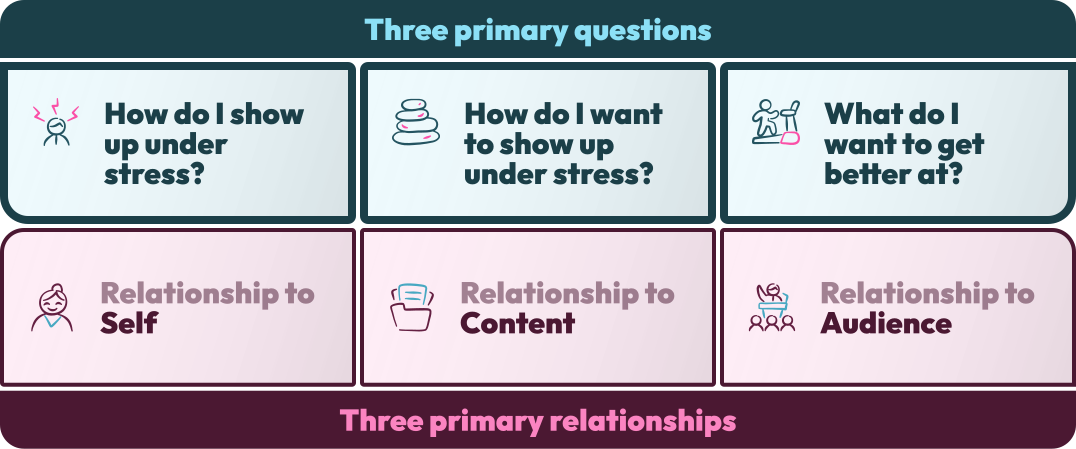
Three primary questions. Three primary relationships. The Six Box Model is an ongoing exercise in curiosity, growth, and choice—a path to giving grace for yourself and others.
What’s missing from most leadership tools
Personality profiles tell you who you are. Understanding ourselves becomes more valuable when in context with our relationships to our content and to our audience.
The Six Box Model™ is a portal we step through into a new practice. It grows with us and scales from personal development, to teams and functions, families and communities, and ultimately reveals a field of unlimited opportunity.
Three questions
We begin with the permission to notice how we show up under stress without judgement or correction.
How do I show up under stress?
What abilities do I lose under stress that I have an abundance of when I am relaxed? Does my audience know more about how I show up under stress than I do?
How do I want to show up under stress?
Practice with the first question leads us to the second. Will we let our stress choose how we show up or will we reclaim that choice?
What do I want to get better at?
If there is a gap between how I am showing up under stress and how I would choose to, what competencies do I want to get better at to close that gap?
Relationship to self
How’s my breathing? How’s my sleep? Am I kind to myself or not? Am I a good partner for communication? Can I notice without judgement or correction? Let’s take a breath.
Relationship to content
What is my content? What am I good at? How did I learn it? What value am I bringing? What is my offer to the workplace and the world? How much of my content is from my own experience versus someone else’s?
Relationship to audience
Does my audience feel seen, heard - and who decides? (The audience does.) Does my audience feel invited to inform my content? Does my audience feel necessary for this presentation? What is my feedback process? What is it really in service of?
Three relationships
Communication involves managing three relationships simultaneously. Chances are we are good at all three. Managing them at the same time is easier than we think.
Where the questions meet the relationships
Each of the six boxes can stand alone. But applying the questions to the relationships in real time reveals a practice and a new field of opportunity.
The six box remains consistent. It is life that is constantly changing. Using this framework is not only an insightful self-coaching tool, it is also scaleable, and can grow to include teams, functions, communities, and whole enterprises. Try it out!
Aim high!
What's the best thing that can happen?
Asking this question, really living in it, can rewire our brains and reframe our worldview. Before we collapse into mitigation of what is possible or not, imagine driving towards best possible outcomes.
Autonomy and community
Autonomy and community exist simultaneously, and honoring both is the path to effective engagement.
More than one thing can be true simultaneously. The more presenters and audiences collaborate, the more potential is revealed.
Ready to practice the framework?
Questions we hear
The six-box model is a combination of three ontological questions used on three primary relationships. We use the questions as lenses to look through and observe the relationships under different conditions. It is the aperture that we step through to do all of our coaching at Connection Lab. It is a tool for self-coaching, group coaching, and enterprise development.
Simply start by reading the six boxes out loud. Notice which questions and relationships might stand out to you. Notice if, during any of that process, you find yourself diving deeper into a specific experience or feeling. If you start judging yourself or find yourself leaning into some kind of corrective behavior - use the phrase "isn't that interesting?" This process is not about judgment or correction, and using that phrase helps us notice how we are showing up under stress without either. Using the six box is a practice focused on language that helps us both notice and choose how we show up and what we want to get better at.
Ontological coaching is a holistic methodology that works at the level of worldview — shifting the core language, emotions, and physical presence that shape how we show up in every relationship and conversation.
Unlike conventional coaching, it doesn't just address surface problems. It transforms how we perceive ourselves and others, creating new possibilities for action in the moments that matter most: the high-stakes presentation, the difficult team conversation, the leadership challenge that reveals who we really are under pressure.
The result is sustainable change across the full spectrum of personal and professional development — from communication skills and public speaking confidence to team dynamics, civil discourse, and conflict resolution — and the kind of self-awareness that makes genuine leadership possible.
We go beyond diagnosing what's broken. We expand what's possible. Learn more→
Connection Lab coaching combines the 6 Box Methodology with ontological coaching to help executives and managers work through the challenges they’re facing and reach their professional goals. Each 60-minute Zoom session gives you a focused space to grow, both in your leadership and in your daily engagement practice.
Coaching is flexible. Programs typically run 3 to 12 months, with weekly, biweekly or monthly sessions. They can be part of a leadership development program or focus on a specific business challenge, such as preparing for a keynote, navigating change, managing conflict or improving communication.
We know these tools firsthand. We've used them, facilitated them, and seen the value they create. Organizations reach for them for good reason: they're accessible, they build a shared language quickly, and people genuinely enjoy the experience. The debrief is often the best conversation of the quarter.
And then everyone goes back to work.
The labels stick, but the behavior doesn't change. The insight stays in the room. It rarely survives first contact with a difficult conversation, a high-stakes presentation, or a team under pressure. That's not a failure of the tools — it's the limitation of what any diagnostic can do on its own.
Connection Lab works where these tools stop. Drawing on the communication principles of the performing arts and ontological coaching, our experiential workshops develop the live, embodied practice of human engagement — in the room, under pressure, in the conversations that determine outcomes. Our Lab Pass platform keeps the practice going — because lasting change requires what the performing arts have always known: relationship, repetition, and support, until new ways of showing up become simply who you are.
The question we start with isn't what type are you? Instead, we ask: how do I show up under stress? How do I want to show up — and, if there is a gap, what competencies do I want to get better at? Those questions scale. They work for the individual, the team, and the organization as a whole.
Beyond a snapshot of ourselves in a single moment in time, Connection Lab develops the competencies of engagement and collaboration — ingredients for progress in both personal and professional development.
Keynote. Zoom. Boardroom. Film. TV. Most presentation skills training focuses almost exclusively on content — crafting the message, building the deck, choosing the words. Connection Lab is different. We recognize that powerful communication requires more than great content. It requires a somatic practice, and the competencies of a real relationship with your audience. Whether you're delivering a keynote, leading a team, or showing up on camera, we help you get better at all of it — public speaking, presence, and human engagement — wherever you need to show up.
Diagnosis is extremely valuable in a wide variety of fields. However, it's often conflated with practice. Diagnosis is not practice. People often assess a situation and imagine themselves changing their practice without actually doing it. Changing one's practice can be intimidating, so it is helpful to remember that we are practicing already all day, every day.
Modifying our practice, even the tiniest amount, can lead to profound growth.