The most human experience you can have online
Pick a date, register, and join a human connection workshop like no other. Together we explore what it means to feel seen, heard, and truly connected. Best show online — and you're the star.

How public workshops work
Workshop format
A little theory, some content generation, then we dive straight into experience. Whether your cohort is people you know or new connections from around the world, you'll practice the competencies of human engagement through games and challenges that elevate everything.
Small groups by design
Workshops host between 4-6 participants because small groups are the most fun. Each module is three and half hours on Zoom and facilitated by a certified Connection Lab practitioner.
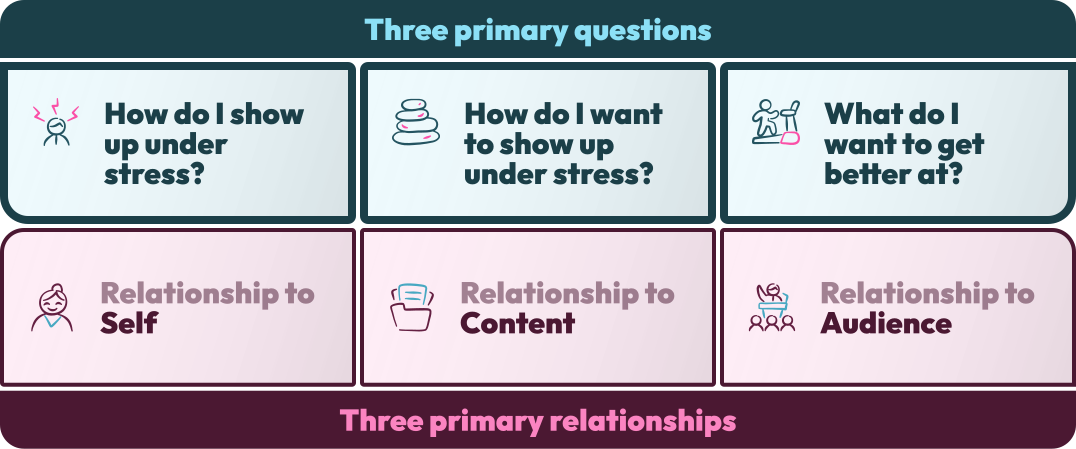
Built on our Six-Box Model™
The portal for developing human engagement competencies.
Three questions applied to three relationships. A practice for raising to consciousness how you show up under stress, deciding if that's how you want to, and simplifying the nature of my relationships.
What you'll practice
Public Workshops offer three foundational modules, the building blocks of human engagement practice.
Module 1
Relationship
Curiosity and invitation are competencies — and prioritizing your relationship with the audience over your content is a choice. When your audience feels seen and heard, a whole new world of collaboration emerges.
Module 2
Demand
Now that the audience feels seen and heard, calling them to action becomes a trust building function rather than a trust diminishing one. Your audience now has an appetite for action verbs not passive ones.
Module 3
Storytelling
Storytelling is essential for sharing context, values, ethics, and vision — but perhaps most importantly, it's what we humans do under stress. Understand the craft of storytelling and lead with it fully.
Note: Modules 4–6 (Atmosphere, Imagery, and Leadership) are available through Organization Programs for teams.
Flexible by design
No corporate training calendar.
No cohort commitment.
Practice when you're ready.
Remote and connected
The principles of human engagement thrive in all environments - join a workshop and learn how →
On-demand sessions
Sessions scheduled based on demand, not arbitrary training cycles. Register when you are ready →
One module or three
Complete a single workshop or the full series. After your first session, you get Lab Pass app access for ongoing practice.
This might be for you if...
You’re exhausted by programs that analyze your personality but don't foster human engagement
You want to be more collaborative, but “presentation skills training” makes you cringe
You freeze in high-stakes moments and want to show up better
You have an instinct for human engagement — you just want to know how to get there.
You’re ready for practice, and engagement curious

Stay connected with Lab Pass
Continue your cohort experience
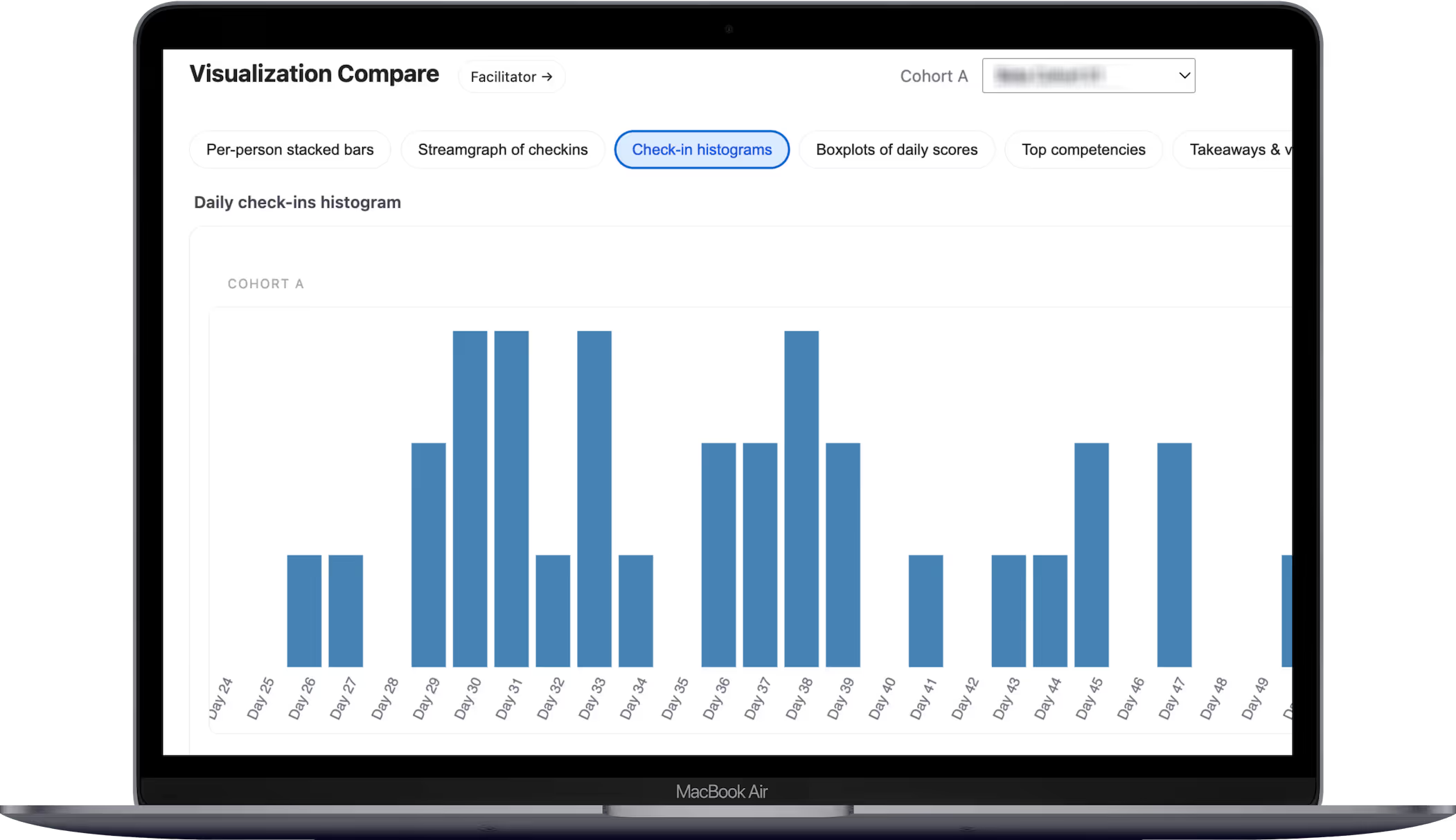
Your first workshop is just the beginning. The Lab Pass — our practice app — keeps you connected to your cohort, your Six Box, and your human engagement competencies.




Workshop cover charge
$250
Regular public workshop price: $250 per seat
Group bookings (4-6): Get in touch to schedule.
Enterprise teams: Check out our programs built for scale.
Real practice, real change
More than a decade of workshops
years of practice
People found what they came for
satisfaction rate

“The way the Connection Lab workshop is structured this experience is very simple, yet very powerful. People didn't expect something so simple to be so powerful.”


“My Connection Lab experience has opened a new door to my professional development. I see the benefits of my program in both my work and personal relationships. My staff is more responsive to me, as is the most senior management.”

“I got so much more value out of it than I ever could have imagined. A true watershed moment for finding a voice that I didn't know I possessed and finding a comfort in myself that didn't feel achievable to me.”

Questions we hear
Public Workshops are $250 per seat for individuals (scholarship pricing available on request). Each is a 3½-hour live online workshop, facilitated by a certified Connection Lab practitioner in a small group of 4–6 people. Together we practice the competencies of human engagement — collaboration, confident presence, and empathy for your audience — in leadership, team, and community settings. Choose from three modules: Relationship, Demand, and Storytelling. Your first workshop includes access to the Lab Pass app for ongoing practice. Enterprise Programs are custom-quoted based on team size, program options, and engagement length.
The Lab Pass is a secure web app designed to keep your human engagement practice going between workshops. Stay connected to your cohort, check in with the growing Connection Lab community, and practice the Six Box framework with the people who get it. Fun, simple, and built for real development. Check out the overview - the Lab Pass access is included with your first workshop. →
Yes. Connection Lab workshops run both in-person and on Zoom — and the practice works equally well either way. We've facilitated for teams across six continents and dozens of industries — including non-profit, finance, technology, mining, healthcare, education, legal, real estate, consulting, engineering, HR, recruiting, startups, media, government, and professional services. The skills of human engagement — connection, presence, and audience awareness — translate across geography, culture, and industry, whether you're in the room or on the screen. Get in touch and we'll talk through what makes sense for your setup.
Typically, each workshop is three and half hours. Unlike multi-month leadership programs or long-term coaching commitments, you can start with a single module and go from there. Some people complete all three modules in short order. Others space them out over months. You choose your own schedule. The practice works no matter what. Come to one workshop, see how it lands, and let that guide what comes next.
Every workshop opens with introductions, a discussion about best outcomes, and an introduction to the 6 Box philosophy. Then participants generate some written content, and we all dive straight into experience. Whether your cohort is people you already know or new connections from around the world, you'll practice the competencies of human engagement through games and challenges that elevate everything. Our experiential workshops host 4–6 participants — small by design, because that's where the real learning and the most fun happen. Sessions are three and half hours on Zoom, facilitated by a certified Connection Lab practitioner. We are a small, engaged group doing the work together.
This work is for anyone who feels isolated and unsure about their ability to connect with others. It is for the experienced presenter who wants to level up. This work is for anyone who wants to build their capacity for empathy or increase innovation and productivity through collaboration. This work is for individuals, teams, and organizations that want to fulfill their potential through co-creation.
We know these tools firsthand. We've used them, facilitated them, and seen the value they create. Organizations reach for them for good reason: they're accessible, they build a shared language quickly, and people genuinely enjoy the experience. The debrief is often the best conversation of the quarter.
And then everyone goes back to work.
The labels stick, but the behavior doesn't change. The insight stays in the room. It rarely survives first contact with a difficult conversation, a high-stakes presentation, or a team under pressure. That's not a failure of the tools — it's the limitation of what any diagnostic can do on its own.
Connection Lab works where these tools stop. Drawing on the communication principles of the performing arts and ontological coaching, our experiential workshops develop the live, embodied practice of human engagement — in the room, under pressure, in the conversations that determine outcomes. Our Lab Pass platform keeps the practice going — because lasting change requires what the performing arts have always known: relationship, repetition, and support, until new ways of showing up become simply who you are.
The question we start with isn't what type are you? Instead, we ask: how do I show up under stress? How do I want to show up — and, if there is a gap, what competencies do I want to get better at? Those questions scale. They work for the individual, the team, and the organization as a whole.
Beyond a snapshot of ourselves in a single moment in time, Connection Lab develops the competencies of engagement and collaboration — ingredients for progress in both personal and professional development.
After the workshop, you will likely feel a glow of energy from the experience. In service of keeping that warmth alive, you'll be invited to join your cohort in what we call the Lab Pass — our practice web app designed to support your ongoing development of human engagement. Use it to stay connected to your team and practice the tools and language of the Six Box Model. Shared practice is proven to be more effective than going it alone — and your cohort will support you every step of the way.
It is all good. This experience is not about changing who you are. It is about expanding your understanding of what human engagement is specifically so you can choose to collaborate when it feels right to you. All are welcome in these Connection Lab workshops. Don't be surprised if you have blast.
Keynote. Zoom. Boardroom. Film. TV. Most presentation skills training focuses almost exclusively on content — crafting the message, building the deck, choosing the words. Connection Lab is different. We recognize that powerful communication requires more than great content. It requires a somatic practice, and the competencies of a real relationship with your audience. Whether you're delivering a keynote, leading a team, or showing up on camera, we help you get better at all of it — public speaking, presence, and human engagement — wherever you need to show up.
For intact teams, Enterprise Programs might be a better fit—we custom-design for your team's actual challenges, and we work alongside you to meet your goals. Public Workshops are great for individuals or small groups from different companies. But if you want to move your whole team, Enterprise is the way.
It is not required that you take all three modules, but don't be surprised if, after the first one, you have a strong appetite to find out what is next. Each module builds on the experience of the previous events, and the result of taking all three will be a deep understanding of how human engagement works and a powerful practice you can share with others.